Inspirations
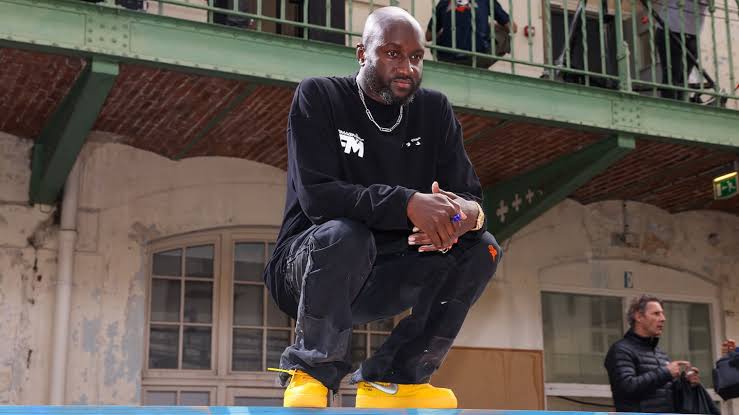
Virgil Abloh
Why It's Here
An engineer who redrew fashion's blueprint.
Virgil Abloh trained as an engineer and an architect, not a tailor, and it showed in everything he made. He spent a decade moving between streetwear, sneakers, furniture, cars, and one of the oldest houses in French luxury, treating each as the same design problem: what do people actually wear, use, and believe in, and how do you say that plainly. He also spent that decade actively building a door for the next generation to walk through it. Both halves of that are why he belongs in this chapter.
Trajectory
Engineering, architecture, then Rome
Abloh was born in 1980 in Rockford, Illinois, to parents who had immigrated from Ghana. He studied civil engineering as an undergraduate, then earned a master's in architecture at the Illinois Institute of Technology, a school built on Mies van der Rohe's own campus design and steeped in the modernist thinking Abloh would later cite as a direct influence on how he approached fashion: structure first, ornament second.
He and Kanye West had already crossed paths in Chicago in the early 2000s, bonding over a shared interest in art, architecture, and fashion, before the relationship became a working one: in 2009 the two interned together at Fendi in Rome, the moment that shaped the next decade for both of them. Abloh went on to art-direct for West's DONDA creative agency and worked on the visual identity around the Watch the Throne era. In 2012 he launched Pyrex Vision, a small, deliberately blunt project that reworked flannel shirts and marked up the price, more a provocation about value and access in fashion than a lasting label. Off-White followed in 2013, built in Milan as the real, sustained version of the idea.
In March 2018, Louis Vuitton named Abloh artistic director of menswear, the first African American designer to hold that position at a French luxury house of that scale. He held the role until his death in November 2021, from a rare form of cardiac cancer he had kept private for roughly two years while continuing to design and show collections.
Vision & Principles
The 3 percent approach
Abloh described his own method as changing an existing, familiar design by roughly 3 percent, just enough to make it unmistakably his, without pretending the original didn't exist. It was an architect's answer to a fashion question: renovate the structure, don't tear it down.
The clearest expression of that idea was his use of quotation marks, printing the word "SHOELACES" on shoelaces, "AIR" inside an Air Jordan, "CHAIR" on a chair. Borrowed from Marcel Duchamp's readymades, the device asked a plain question about function and value: what makes an object what we call it, and who gets to decide. That same instinct, take the ordinary thing and make people look at it again, ran through his DJ sets, his gallery shows, and his product design as much as his collections.
He was also explicit about wanting to lower the gate, not just walk through it: streetwear as a bridge between a housing project and a couture house, sneakers treated with the same seriousness as tailoring, and a refusal to pretend that hype and craft were opposites.
Key Collaborations
Sneakers, flat-pack furniture, and a G-Wagon
Nike, "The Ten," 2017. Abloh took ten of Nike's most recognizable silhouettes, the Air Jordan 1 and Air Force 1 among them, and deconstructed them: exposed foam, visible stitching, zip ties, his quotation marks labeling the parts. It reset how sneaker collaborations were received and priced, and Nike and Off-White kept building on it in the years after.
IKEA, "MARKERAD," 2019. A furniture collection that put his industrial, signage-heavy language onto everyday objects: a doormat printed "WET GRASS," a rug patterned like a receipt. Priced for IKEA's usual customer, not a luxury one, it was one of the plainest statements of his belief that good design shouldn't require a luxury budget to reach people.
Mercedes-Benz. Abloh worked with Mercedes-Benz on Project Geländewagen, a reimagined take on the G-Wagon unveiled in 2020, treating the vehicle as a "vision" object rather than a production plan, off-road heritage reconsidered through his industrial-fashion lens.
Kanye West. Beyond the early Fendi internship and DONDA work, Abloh remained closely tied to West's visual world through the following decade, two friends from the same Chicago-adjacent scene who pushed each other into fashion at roughly the same moment.
Louis Vuitton. His menswear collections mixed tailoring with streetwear staples, brought skateboarding and hip-hop references onto the runway of a 167-year-old house, and closed, after his death, with a posthumous collection built from the ideas he had left in progress.
Giving Back to Creatives
Building the door, not just walking through it
Abloh set up a scholarship fund, run with Nike and the Fashion Scholarship Fund, aimed at students of color pursuing fashion education, a direct response to how few designers who looked like him he'd seen ahead of him when he started. He mentored openly, taught and lectured at schools and institutions, and was known for answering young designers who reached out to him directly rather than through a gatekeeper. The apprentices he shaped this way are, by design, still working through fashion today.
Why It Belongs Here
An engineer's discipline, an architect's structure, and a deliberate hand held out behind him. Virgil Abloh remade fashion and then spent his decade making sure it wasn't a door that closed after him.
Back to Inspirations