Inspirations
SpaceX
Why It's Here
The rocket that lands instead of getting thrown away.
The manifesto already names Fiat, Ford, and Tesla for remaking transportation on the ground. SpaceX is the same instinct pointed at orbit: an industry that had accepted, for sixty years, that a rocket is a one-use object, rebuilt around the idea that it doesn't have to be. That single reversal is the whole story here, everything else, the cost collapse, the launch pace, the crewed missions, follows from it.
History
Three failed launches from running out of money
Elon Musk founded SpaceX in 2002 after selling PayPal, with a stated goal that sounded closer to science fiction than a business plan: make humanity a multi-planetary species, starting with Mars. The company's first rocket, Falcon 1, failed on its first three attempts, in 2006, 2007, and 2008. By Musk's own account, SpaceX was weeks from running out of money when the fourth launch, in September 2008, finally succeeded.
That near-miss was followed almost immediately by the moment that actually secured the company's future: a $1.6 billion NASA contract that December for cargo resupply missions to the International Space Station. A government agency betting on a four-launch-old startup, over the established aerospace primes, is its own small story about what NASA was willing to risk to get a second way of reaching orbit.
The Breakthrough
Landing the booster, not discarding it
For the entire history of orbital spaceflight before SpaceX, a rocket's first stage, the expensive part, the engines, the tanks, the structure, burned its fuel and fell into the ocean, every single flight. Recovering and reflying it was widely treated across the industry as uneconomical at best, physically impractical at worst. SpaceX built the Falcon 9 to prove otherwise: a first stage that flies itself back down and lands upright, first successfully on land in December 2015, then on an ocean drone ship the following year.
Reuse didn't just save fuel, it rewrote the cost structure of getting to orbit at all, the single biggest reason launch prices fell as fast as they did through the 2010s and 2020s, and the reason a SpaceX launch became something that could happen weekly rather than a handful of times a year.
Scale Today
Crewed launches return to American soil
In May 2020, SpaceX's Crew Dragon carried NASA astronauts to the International Space Station, the first crewed orbital launch from American soil since the Space Shuttle retired in 2011, and the first time a privately built and operated spacecraft had ever carried astronauts to orbit at all. For nine years in between, the only way there had been buying seats on Russian Soyuz rockets.
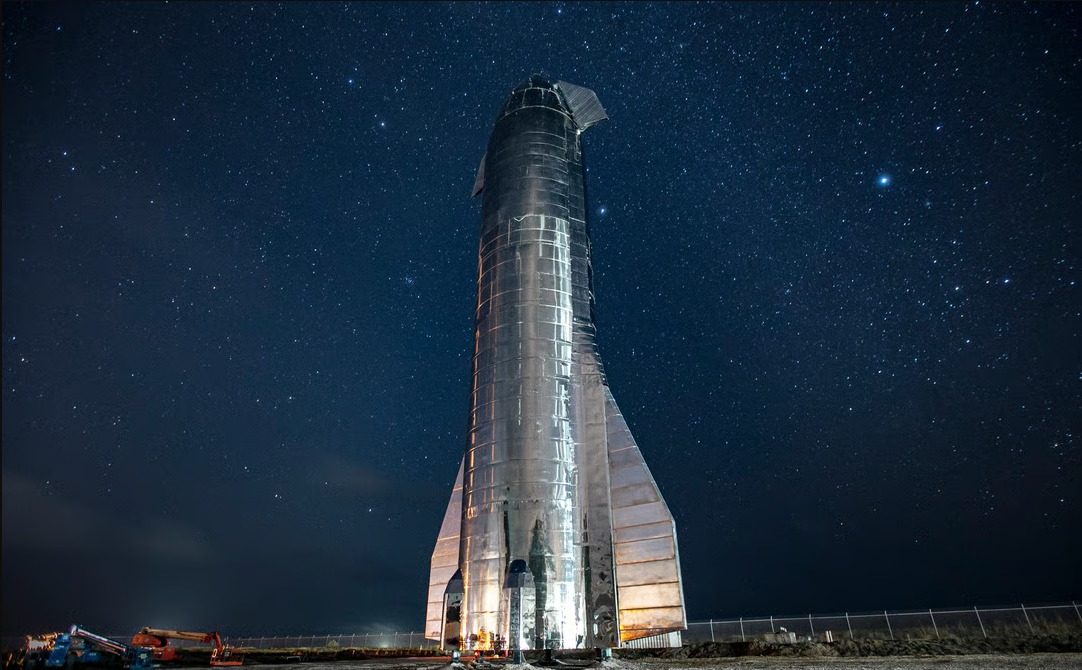
Starlink, the company's satellite internet constellation launched from 2019 onward, became the largest satellite network ever built and, deliberately, a revenue engine for the more expensive ambitions underneath it: Starship, the fully reusable vehicle built for Mars and, closer to hand, selected by NASA to land astronauts on the Moon again under the Artemis program. The Mars goal from 2002 is still the stated destination, everything shipping today is still explained as a step toward it.
Why It Belongs Here
An industry that had settled into throwing away its most expensive part on every flight, rebuilt around the idea that it didn't have to. Three failures from bankruptcy, then a bet from the one customer with the most to gain from a second option existing at all. That's the same shape as everything else standing on the shoulders of giants in this chapter, just pointed up instead of down the road.
Back to Inspirations